
An in depth autopsy of the Indian Super League’s financial skeleton, exploring why even 100 million viewers cannot seem to stop the bleeding in club balance sheets during the 2026 reconstruction.
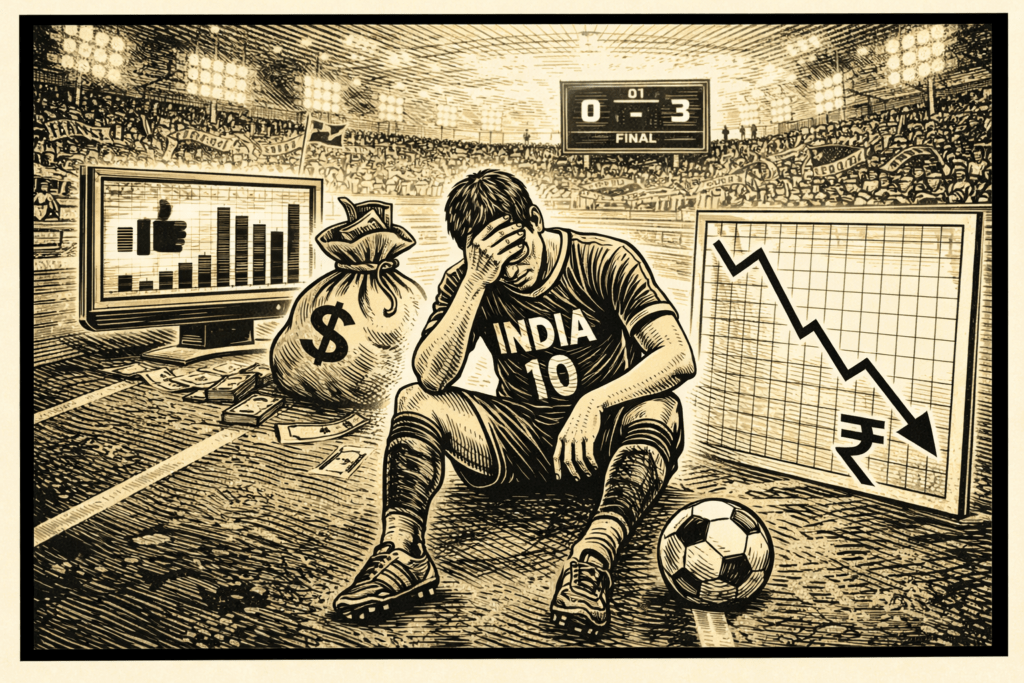
If you walked into a boardroom in 2024 and said, “I have a product that reaches 100 million people,” you would be handed a blank check and a celebratory bouquet. But in the 2025 to 2026 season of the Indian Super League (ISL), that same sentence usually ends with a club owner asking the players to take a 30% pay cut.
Historically, the ISL has been a masterclass in “Irrational Exuberance.” It is a league where the viewership is cinematic, but the bank statements look like a horror script.
As the Master Rights Agreement (MRA) expired in late 2025 and the league entered its “emergency” 2026 season, the mask finally slipped. We are no longer just looking at a “negative bottom line”; we are looking at a structural deficit that high television ratings alone cannot fix.
1. The Revenue-Retention Gap: The 90/10 Rule
The biggest reason for the negative bottom line is the “Cricket Shadow.” In the Indian media market, approximately 90% of all sports ad spending is swallowed by cricket.
Even when the ISL records a massive 100 million viewers (as Sony SPNI reported in 2025), the Average Revenue Per User (ARPU) is a fraction of what a cricket viewer generates.
Brands are willing to pay a premium for the IPL because it is a “guaranteed” purchase driver. For football, they offer “experimental” rates. Consequently, clubs have historically been left with a central revenue share that does not even cover the interest on their initial franchise fees.
2. The High-Octane Expenditure Model
For the first decade, ISL clubs operated on a “spend now, pray later” philosophy. To create the “glamour quotient,” teams overspent on two specific areas that cannibalized their budgets:
- The Foreign Player Premium: Until the 2026 market correction, clubs were spending crores on aging European or South American stars. While these players brought “clicks,” they did not bring “commercial sustainability.”
- The Infrastructure Tax: Most ISL clubs do not own their stadiums. In 2026, clubs collectively petitioned the government for subsidies on stadium rentals and security costs.
- When you have to pay a massive daily rent for a government facility and then spend more to fix a pitch that was used for a political rally the week before, your profit margin evaporates before kickoff.
3. The “Post-MRA” Shock of 2026
The expiration of the MRA in December 2025 was the “Minsky Moment” for Indian football. For 15 years, the commercial partner (FSDL) acted as a buffer. In the 2026 reconstruction, that buffer is gone.
| Financial Metric | The FSDL Era (Pre-2025) | The AIFF/Club Era (2026) |
| Central Rights Value | ~₹275 Crore/year | ₹8.62 Crore (FanCode Deal) |
| Club Burden | Subsidized operations | Total operational exposure |
| Market Valuation | ₹465.8 Crore | ₹283 Crore (40% Drop) |
The drop from ₹275 crore to ₹8.62 crore in media rights value is the most violent “Reality Check” in sports history. It proves that viewership does not equal value if you cannot monetize it through a competitive bidding war.
4. The “No Semifinals, No Profits” Format
To survive the 2026 crisis, the AIFF introduced a truncated, single-leg “Swiss System” format. While this saved the league from total cancellation, it destroyed the “matchday economy.”
- Fewer Matches = Fewer Ads: With only 13 games per team instead of 24, the inventory for sponsors has halved.
- No Playoffs: Historically, the semifinals and finals were the only matches where ticket prices could be “premiumized.” By moving to a table-points champion model, clubs lost their biggest “big ticket” revenue event.
5. The “Sacrifice” Era: Can it Work?
In early 2026, Bengaluru FC owner Parth Jindal famously called on players to make “sacrifices.” This is the new “Bottom Line” strategy: Internal Devaluation. If you cannot increase the top-line (revenue), you must slash the bottom-line (wages).
- The Salary Cap Trap: Clubs are now pushing for a much lower salary cap, but they are trapped by existing multi-year contracts.
- The Relegation Fear: Clubs have also sought a “stay on relegation” for three seasons. Why? Because the financial cost of dropping to the IFL (second tier) is essentially a death sentence for a franchise with crores in liabilities.
The Verdict: A Leaner, Meaner, or Deadlier Future?
The historical struggle with a negative bottom line was caused by a mismatch between “First World” ambitions and a “Developing Market” commercial reality. The 2026 season is the first time the ISL is looking at its bank account without rose-tinted glasses.
The league is currently in “Safe Mode.” Sustainability will not come from more viewers, it will come from cost-efficient infrastructure, localized sponsorships, and a realistic player wage structure.
Until the ISL can prove it can run on ₹24 crore rather than ₹70 crore, the bottom line will remain a sea of red, no matter how many millions are watching on their phones.