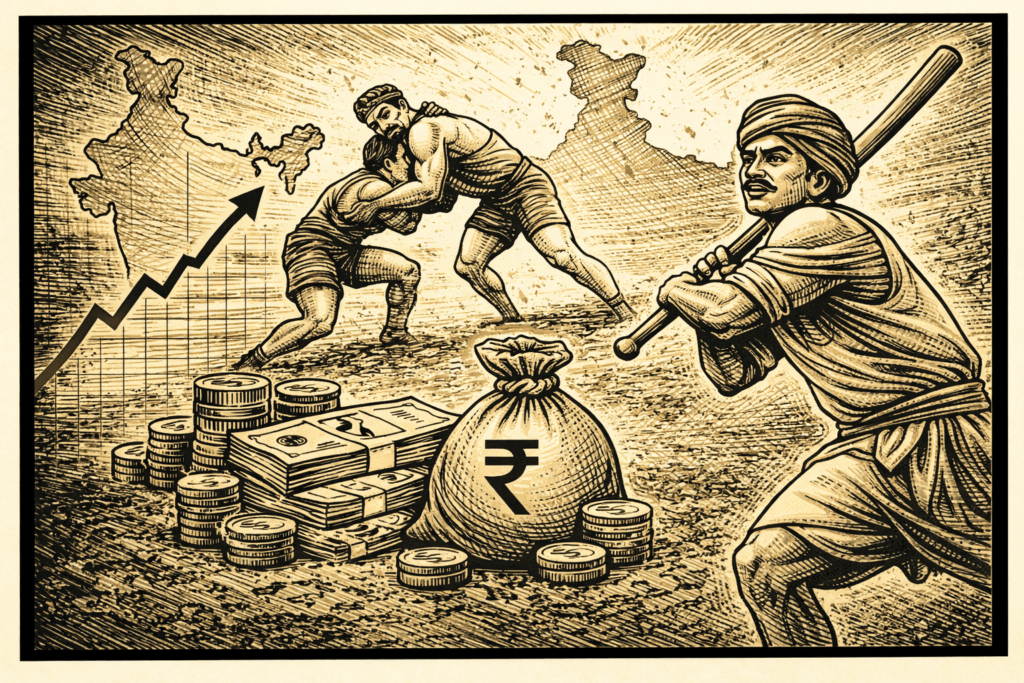

Why Kabaddi and Kho-Kho are Winning the “Heartland” War
For decades, the Indian sports economy was a monologue written in the language of cricket. But as we move through 2026, that monologue has turned into a diverse, high-energy conversation.
While cricket remains the undisputed commercial titan, it is experiencing a “plateau effect.” Data suggests that while cricket’s growth has stabilized at a respectable 5%, indigenous sports like Kabaddi and Kho-Kho are surging with annual growth rates of 15% to 20%.
The shift is not just about numbers; it is about a profound cultural realignment. Indigenous sports are no longer viewed as “rural pastimes”, they are being recognized as the high-octane, sustainable future of Indian sports media.
1. The Numbers: Growth vs. Saturation
Cricket’s 5% growth is a sign of a mature, nearly saturated market. With back-to-back global tournaments and a year-round IPL ecosystem, the “novelty factor” for cricket has begun to thin. In contrast, indigenous leagues are tapping into fresh, massive reserves of untapped attention.
| Sport / League | Viewership Growth (YoY) | Key Audience Segment |
| IPL (Cricket) | ~5% | Urban/Pan-India |
| Pro Kabaddi (PKL) | 18% – 22% | Tier-II, Tier-III & Rural |
| Ultimate Kho-Kho (UKK) | 15% – 20% | Youth & Female (40% share) |
The Pro Kabaddi League (PKL) Season 12 recently recorded a 22% growth in watch-time and a 3X jump in digital reach. This suggests that the “second-most popular” sport in India is no longer just a placeholder; it is a primary destination for a new generation of viewers.
2. The Tier-II and Tier-III Connection: Identity over Aspiration
Why are audiences in places like Kolhapur, Rohtak, and Berhampur choosing the “mat” over the “pitch”?
- The Relatability Factor: Cricket has become increasingly aspirational and “elite.” In contrast, Kabaddi and Kho-Kho are the “Maati ke Khel” (Games of the Soil). The athletes often hail from the same small towns as the viewers, creating a “hero next door” narrative that international cricket lacks.
- Fast-Paced Formats: In an age of shrinking attention spans, a 40-minute Kabaddi match or a high-speed Kho-Kho chase offers more “action per minute” than even a T20 game. The “Powerplays” and “Tie-breaker” rules introduced in 2025–26 have further gamified these sports for a digital-first audience.
- Vernacular Victory: Indigenous leagues have mastered the art of local storytelling. By offering commentary in over 10 regional languages, they have broken the “English-Hindi” duopoly, making the sport accessible to the 60% of India’s sports audience that lives in rural areas.
3. The Economics of Sustainability
For brands, the “Indigenous” boom offers a different kind of ROI. While an IPL spot might cost a king’s ransom, the PKL and UKK offer high regional engagement at a fraction of the cost.
- The UKK Case Study: Ultimate Kho-Kho (UKK) achieved a net media value of over ₹130 crore within its first two seasons. More impressively, it has managed to attract a 40% female viewership, a demographic that traditionally felt excluded from male-dominated sporting broadcasts.
- Lower Barrier to Entry: Local brands, from tractors to regional cement, can now own a “Title Sponsorship” for a professional league, something that would be financially impossible in the IPL ecosystem.
4. The Digital Transformation
The rise of JioStar and other OTT platforms has been the “X-factor” for these sports. Digital reach for the PKL grew by 3X in 2025–26 because these platforms allow for “hyper-local” targeting.
A fan in Tamil Nadu can watch a Kabaddi match with Tamil commentary, real-time local stats, and ads for local businesses, all on their mobile screen.
The Verdict: A Multi-Sport Powerhouse
By 2030, India’s sports industry is projected to reach $130 billion. This growth will not be driven by cricket alone. The “Reconstruction” is already underway: cricket provides the global scale, while Kabaddi and Kho-Kho provide the sustainable, grassroots soul of the economy.
As we look toward the 2036 Olympic bid, these indigenous sports are proving that India does not need to import its sporting culture. We already have it; we just needed to give it a prime-time slot.

