
The “State-Sponsorship” Monopoly: Why Odisha is the Only Player on the Field (and Why the Rest are Still Warming the Bench)
In the high-stakes world of Indian sports, a revolution didn’t start with a multi-billion dollar corporate merger or a flashy IPO. It started with a state government deciding that “Hockey is Life” wasn’t just a Pinterest quote, but a fiscal policy.
The Odisha Model has fundamentally rewritten the playbook of sports governance. By becoming the first state to bypass the traditional corporate “logo-on-a-sleeve” approach and opting for deep-rooted, long-term national sponsorship, Odisha hasn’t just saved Indian Hockey,it has monopolized the sporting narrative.
While other states are still arguing over stadium maintenance or hosting the occasional regional trophy, Odisha is building world-record-breaking arenas in 15 months and signing decade-long deals that stretch into the 2036 Olympics.
This 1,000-word deep dive analyzes:
- The Mining to Medal Pipeline: How the Odisha Mining Corporation became the secret vault behind India’s Olympic resurgence.
- The PPP Power Move: Why their Public-Private Partnership with legends like Abhinav Bindra and Pullela Gopichand is making “Bureaucratic Inertia” look like a relic of the past.
- The “Sports Capital” FOMO: Why West Bengal, Haryana, and Gujarat are suddenly scrambling to copy a blueprint they ignored for a decade.
- The Elephant in the Room: Is it a sustainable masterstroke or a political monopoly that leaves other states in the dust?
For decades, the standard operating procedure for Indian sports was a chaotic mix of corporate indifference and bureaucratic red tape.
If you weren’t Cricket, you were essentially a Victorian orphan, wandering the streets hoping a conglomerate might drop a few lakhs in your bowl for a “CSR initiative.”
Then came Odisha.
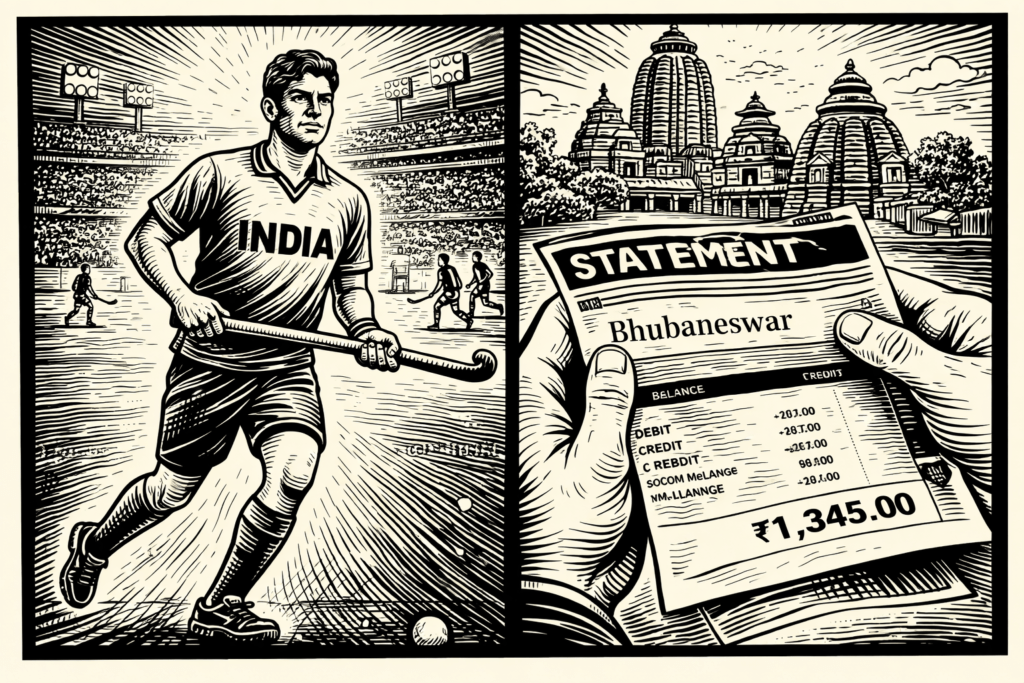
In a move that caught the rest of the country looking the wrong way, the Odisha government—under what many called a “Masterstroke” at the time, stepped in to fill the void left by departing corporate sponsors. They didn’t just put a sticker on a jersey; they became the official sponsor of the Indian National Hockey teams.
Fast forward to 2026, and the “Odisha Model” is no longer an experiment; it’s a monopoly that has turned the state into the undisputed “Sports Capital of India,” leaving other states looking like they’re still playing with a wooden stick in a carbon-fiber world.
The Birth of a Sovereign Sponsor
The genius of the Odisha Model lies in its audacity. Typically, a state government builds a stadium and hands the keys to a sports federation, which then begs a brand like Sahara or Reliance for cash.
Odisha cut out the middleman. By leveraging the Odisha Mining Corporation (OMC), a state-owned cash cow, the government created a direct pipeline from natural resources to national podiums.
When Odisha extended its hockey sponsorship until 2036 (the centenary of the state’s formation and a strategic nod to India’s Olympic bid), they weren’t just thinking about the next game.
They were thinking about a legacy. They turned “State Sponsorship” into a branding exercise so powerful that today, you cannot think of Indian Hockey without thinking of the Kalinga Stadium. It is a psychological monopoly as much as a financial one.
The “High-Performance” Secret Sauce
While other states focus on building “infrastructure” (which usually means a concrete bowl that sits empty 360 days a year), Odisha focused on ecosystems. They didn’t just build the Birsa Munda Hockey Stadium in Rourkela, the world’s largest seated hockey venue in a record 15 months; they built a “Village” around it.
More importantly, they mastered the Public-Private Partnership (PPP) in a way that should make Harvard Business School blush. Instead of government clerks trying to coach athletes, Odisha invited the legends. They set up High-Performance Centres (HPCs) where the government provides the land and the “Hardware,” but the “Software” is run by the best:
- Athletics with the Reliance Foundation.
- Badminton with Pullela Gopichand.
- Shooting with Gagan Narang.
- Sports Science with Abhinav Bindra.
By outsourcing the technical excellence to experts and keeping the funding in-house, they removed the “Red Tape” that usually strangulates Indian sports. In Odisha, if a coach needs a GPS tracker for a sub-junior player, they get it. In other states, they’d still be filling out Form 12-B in triplicate.
Odisha vs. The Rest: The Great Infrastructure Gap
The disparity between Odisha and the rest of India is becoming embarrassing. While states like West Bengal and Goa have rich sporting histories, their infrastructure often feels like a museum to the 1980s.
Odisha, meanwhile, has 17 astro-turf fields in a single district (Sundargarh). To put that in perspective, many entire countries don’t have that kind of density.
The “Rest” are now suffering from a severe case of Sports FOMO. Gujarat is pouring billions into the Ahmedabad sports cluster, and Haryana continues to be a “Medal Factory” based on sheer grit and wrestling pits.
But neither has managed to replicate Odisha’s “Panchayat-to-Podium” model, a digital-first, data-driven system where every athlete has a “Golden ID” and performance is tracked by AI.
The rest of the country is playing catch-up, trying to figure out how a state once known primarily for its temples and mines became the logistical backbone of the Indian Olympic dream.
The Critique: Is it a “Monopoly” or a “Model”?
Of course, you can’t have a monopoly without some grumbling. Critics argue that Odisha is “over-spending” public money on elite sports while the state still grapples with poverty. There’s a valid question: Is it the job of a state exchequer to sponsor a national team?
However, the “Odisha Model” counters this with the Multiplier Effect. Sports isn’t just about medals; it’s about soft power, tourism, and jobs.
Every time Bhubaneswar hosts a World Cup, hotels are booked, flights are full, and “Brand Odisha” rises. It’s not just a sponsorship; it’s an economic hedge. The state has realized that in 2026, being the “Sports Capital” is a more lucrative identity than just being a “Mineral Hub.”
The 2036 Horizon
As India gears up for a potential 2036 Olympic bid, Odisha has already done the homework. They have the venues, the sports science, and the political will. The “monopoly” isn’t just about hockey anymore; with the recent 2025 World Athletics Continental Tour and the upcoming 2028 Indoor Championships, Odisha is branching out into every vertical.
The “State-Sponsorship” Monopoly has created a lopsided reality. If you are a young athlete in India today, your best bet isn’t necessarily being born into a rich family; it’s being born within driving distance of a Kalinga Stadium satellite.
Conclusion: Move or Get Out of the Way
The Odisha Model has proven that when a government treats sports as a priority infrastructure rather than a recreational afterthought, the results are undeniable. The “Rest” of India has two choices: continue to let Odisha hold the megaphone, or start putting their own state-owned corporations to work.
Until then, the podium will continue to speak with an Odia accent.