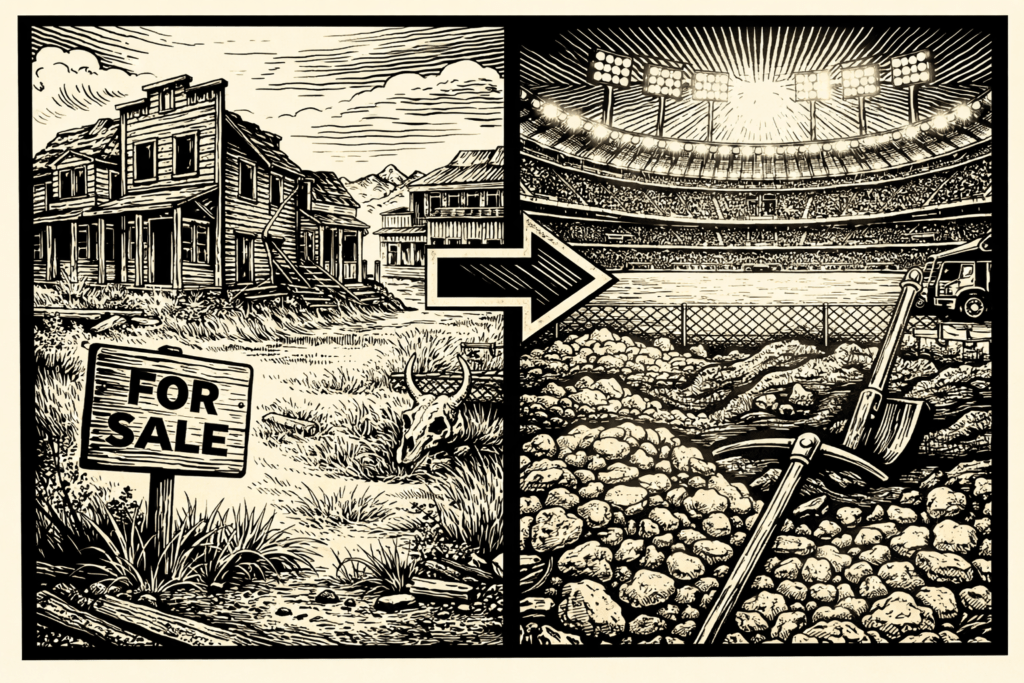

For decades, the lifecycle of a professional sports stadium followed a tragic, predictable arc. A city would cough up a king’s ransom in taxpayer subsidies to build a shimmering palace of glass and steel.
For ten to twelve days a year, the venue would scream with life, overpriced beer would flow like water, and the local economy would get a fleeting shot of adrenaline.
Then, Monday morning would arrive.
The gates would chain shut, the parking lots would become desolate asphalt tundras, and the “palace” would transform into a White Elephant: a massive, expensive, and utterly useless creature that eats maintenance budgets for breakfast while contributing nothing to the neighborhood but a giant shadow.
But it’s 2026, and the “White Elephant” is officially on the endangered species list. Developers and team owners have finally realized that if you’re going to spend $2 billion on a building, it shouldn’t have 300 days of PTO.
Welcome to the era of the Sports-Anchored Mixed-Use District, where the stadium isn’t just a place to watch a game, it’s the anchor tenant of a 24/7, 365-day micro-city.
The Death of the “Game Day” Mentality
The old-school stadium model was built on scarcity. You came for the event, you fought traffic to get out, and you didn’t look back. That model is dead. Today’s sports real estate strategy is built on density and duration.
Modern owners are no longer just “sports moguls”; they are high-stakes real estate developers. They’ve looked at the math and realized that the scoreboard is the least profitable part of the acreage.
The real money isn’t in the ticket sales, it’s in the luxury apartment overlooking the north end zone, the “concept” taco bar in the plaza, and the co-working space that offers “stadium views” to tech bros who want to feel athletic while answering emails.
By surrounding a stadium with retail, residential, and office spaces, teams are creating a captive audience.
You aren’t just a fan who visits on Sunday; you’re a tenant who pays rent on Monday, a shopper who buys groceries on Wednesday, and a diner who grabs a cocktail on Friday. The stadium has evolved from a destination into a neighborhood heartbeat.
The Architecture of the “Always On” Venue
To avoid the “White Elephant” curse, the buildings themselves have had to get a lot smarter. In the past, a stadium was a static bowl. Today, it’s a Swiss Army knife.
Take, for example, the rise of retractable everything. We have retractable roofs (standard), retractable pitches (impressive), and even retractable seating tiers that can shrink a 70,000-seat NFL cavern into a cozy 15,000-seat concert hall.
This modularity is the secret sauce of year-round ROI. If a venue can host a monster truck rally on Tuesday, a corporate tech conference on Thursday, and a Premier League match on Saturday, the “empty days” disappear.
Furthermore, the technology integrated into these districts, often called “PropTech” is terrifyingly efficient. AI-driven systems manage crowd flows not just during games, but throughout the week, adjusting lighting, security, and even “dynamic” storefronts in the surrounding plaza to match the vibe of the day.
If there’s no game, the plaza becomes a public park or a farmers’ market. The goal is to ensure there is never a “dark” night on the calendar.
The “Live-Work-Play-Punt” Lifestyle
The most significant shift in this real estate revolution is the residential integration. We are seeing a “Disney-fication” of the fan experience. Why drive to the stadium when you can live in a condo that is literally attached to it?
Projects like The Battery in Atlanta or the Titletown District in Green Bay have proven that fans will pay a premium to live in the shadow of their team’s logo.
These districts offer a curated lifestyle where the “vibe” of sports, the energy, the community, the brand is baked into the daily routine.
From a real estate perspective, this is genius. It de-risks the investment. Even if the team is having a losing season (looking at you, perennial cellar-dwellers), the bars are still full, the gym memberships are still active, and the rent checks still clear.
The “Sports District” creates a self-sustaining ecosystem that is immune to the win-loss column.
The Economic Pivot: From Subsidy to Synergy
For years, the argument against public funding for stadiums was that they provided no “multiplier effect.” Economists argued that a stadium was an island that sucked money out of the local community.
The “Year-Round District” model is the industry’s rebuttal. By building hotels, medical centers, and grocery stores as part of the stadium complex, developers are creating actual jobs and actual tax bases that exist regardless of the sports calendar. It turns the stadium from a drain on the city’s resources into an economic engine.
Cities are now more willing to greenlight these projects because they aren’t just buying a scoreboard; they are buying a new downtown.
This synergy between the public sector and private sports equity has changed the map of modern urban planning. We are seeing “secondary downtowns” pop up in the suburbs, centered entirely around a high-tech arena.
The Risk: Avoiding the “Synthetic” Trap
Of course, there is a catch. The danger of these year-round entertainment districts is that they can feel… well, fake. When everything is owned by the same holding company from the beer in your hand to the roof over your head—the “soul” of the sports experience can feel a bit manufactured.
The most successful districts are those that manage to integrate with the existing city fabric rather than acting like a gated community for the wealthy. They need to be “porous” inviting the general public in for a jog or a coffee even if they don’t have a $400 ticket.
The “White Elephant” wasn’t just hated because it was expensive; it was hated because it was a wall. The new districts must be bridges.
Final Score: The Future is Mixed-Use
The transformation of sports real estate is a testament to the fact that in 2026, utility is the new luxury. We can no longer afford the vanity of single-use monuments.
The stadium of the future is a chameleon: a stadium by night, a park by day, a shopping mall by weekend, and a residential hub always.
By killing the “White Elephant,” teams are doing more than just saving money, they are becoming permanent fixtures in the lives of their fans. The game might end after four quarters, but the real estate play never stops.

