
The “Policy Box”: Benchmarking the 2036 Olympic Ambition
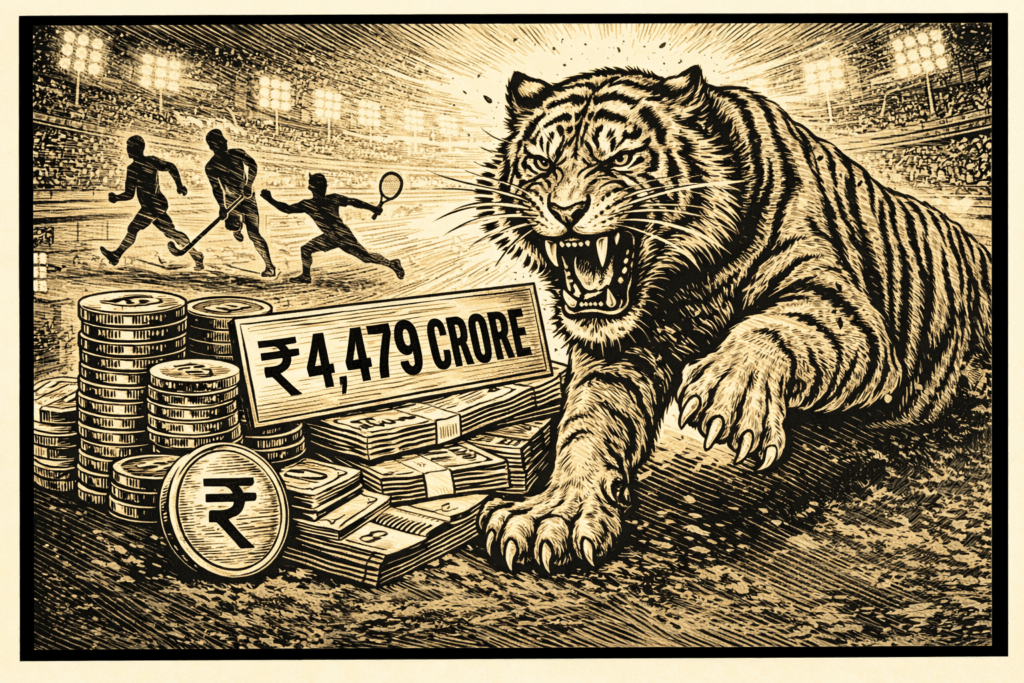
India has officially entered the 2036 Olympic bid cycle with a clear message: we are ready to spend. The Union Budget for 2026 to 2027 has allocated a record ₹4,479.88 crore to the Ministry of Youth Affairs and Sports, a significant jump from the previous year’s revised estimate of ₹3,346 crore.
But while this is “highest ever” territory for India, the “Policy Box” reveals a sobering reality. When compared to the sports spending of Asian powerhouses like Japan and South Korea, India’s record budget is still playing in a different league. To host an Olympics and, more importantly, to win one, the fiscal strategy needs to move from “incremental” to “exponential.”
1. The Policy Box: Asian Sports Spending (2025–26)
To understand where India stands, we must look at the spending per capita and the total investment in high performance ecosystems.
| Country | Sports Budget (Approx. USD) | Per Capita Spend (Approx.) | Olympic Rank (Paris 2024) |
| India | $540 Million (₹4,479 Cr) | $0.38 | 71st |
| South Korea | $1.1 Billion (1.5 Trillion Won) | $21.30 | 8th |
| Japan | $1.4 Billion (210 Billion Yen) | $11.25 | 3rd |
Note: Figures are estimated based on 2025 to 2026 exchange rates and include specific high performance sports council allocations.
2. The Efficiency Gap: South Korea’s “Elite” Focus
South Korea spends nearly 55 times more per citizen on sports than India. But the difference is not just the volume of cash; it is the concentration.
The Korea Sports Council (KSC) recently finalized a 2026 budget of 360.1 billion won ($260 million) specifically for elite athlete villages and medical support. While India’s Khelo India Mission (allocated ₹924 crore in 2026) is wide and shallow—trying to cover millions of kids—South Korea’s model is narrow and deep. They prioritize “strategic sports” where they are historically dominant, such as archery and fencing.
3. The Japan Model: Beyond the Government Purse
Japan’s sports economy is a hybrid powerhouse. While the national budget is roughly $1.4 billion, the actual “Sports GDP” is bolstered by a massive private sector.
- The “J-League” Effect: Japan’s professional leagues are self-sustaining commercial entities that feed into the national pool.
- Infrastructure Utilization: Unlike India, where a ₹500 crore stadium might sit empty for 300 days a year, Japan’s 2026 fiscal policy emphasizes “Living Environments.” Sports facilities are integrated into local community centers, ensuring that the “Administrative Overhead” is shared across health and social welfare budgets.
4. India’s “Reconstruction” Strategy
India is attempting to bridge this gap through the Sports Goods Manufacturing initiative, which received ₹500 crore in the 2026 budget. This is a clever “Indigenous” play. Instead of just spending on training, India is trying to build a manufacturing hub.
If India can become the “factory of the sporting world,” the tax revenue from sports exports could eventually fund the elite training centers that Japan and South Korea currently take for granted. It is a long game, but for a 2036 goal, it is the only viable one.
The Verdict: The Road to 2036
India’s ₹4,479 crore budget is a victory for intent, but a “Reality Check” for scale. We are currently spending cents where our rivals are spending dollars. To truly compete for a Top 10 spot by 2036, India’s sports budget needs to not only grow but also diversify away from government reliance.
We need the private sector to step up, the “Niche Leagues” to become commercially viable, and the administrative bloat to be trimmed so that the money actually reaches the athlete’s plate.